
A hailstorm rips through your county on a Thursday afternoon. By Friday morning, your phone is ringing off the hook with roofing leads. Homeowners are standing in their driveways staring at missing shingles, calling every roofer they can find. You’re already on a tear-off two neighborhoods over. By the time you check voicemail at 4 PM, half those callers have already booked with the company that texted them back in 30 seconds.
This is the roofing leads problem. Your jobs are big-ticket–$8,000 to $15,000 for a typical residential replacement. As a result, every missed follow-up isn’t a lost $200 service call. It’s a lost five-figure job. And unlike plumbers or electricians who run multiple calls per day, you might only close 2-3 roofs per week. Each one matters enormously.
The irony is brutal: the busiest roofers–the ones with the best crews and the most demand–are the ones who lose the most roofing leads. Because they’re on roofs. Not near phones. Not checking email. In fact, the window between an interested homeowner and a signed contract with your competitor can be measured in hours, not days.
Key Takeaways
- Roofing leads are high-ticket ($8K-$15K per job)–a single missed follow-up can cost more than most trades lose in a month
- Three automations close the gap: instant lead acknowledgment, multi-touch estimate follow-up, and post-job review requests
- Storm-season surges flood your pipeline with roofing leads you physically cannot answer from a rooftop–automation catches what you can’t
- A roofing company losing just 3 unworked leads per week during peak season leaves an estimated $150,000+ per year on the table
Why Roofing Leads Have the Worst Follow-Up Problem in the Trades
Every trade has a lead follow-up problem. However, roofing has structural challenges that make it worse than almost any other specialty.
You’re Physically Unreachable for Hours at a Time
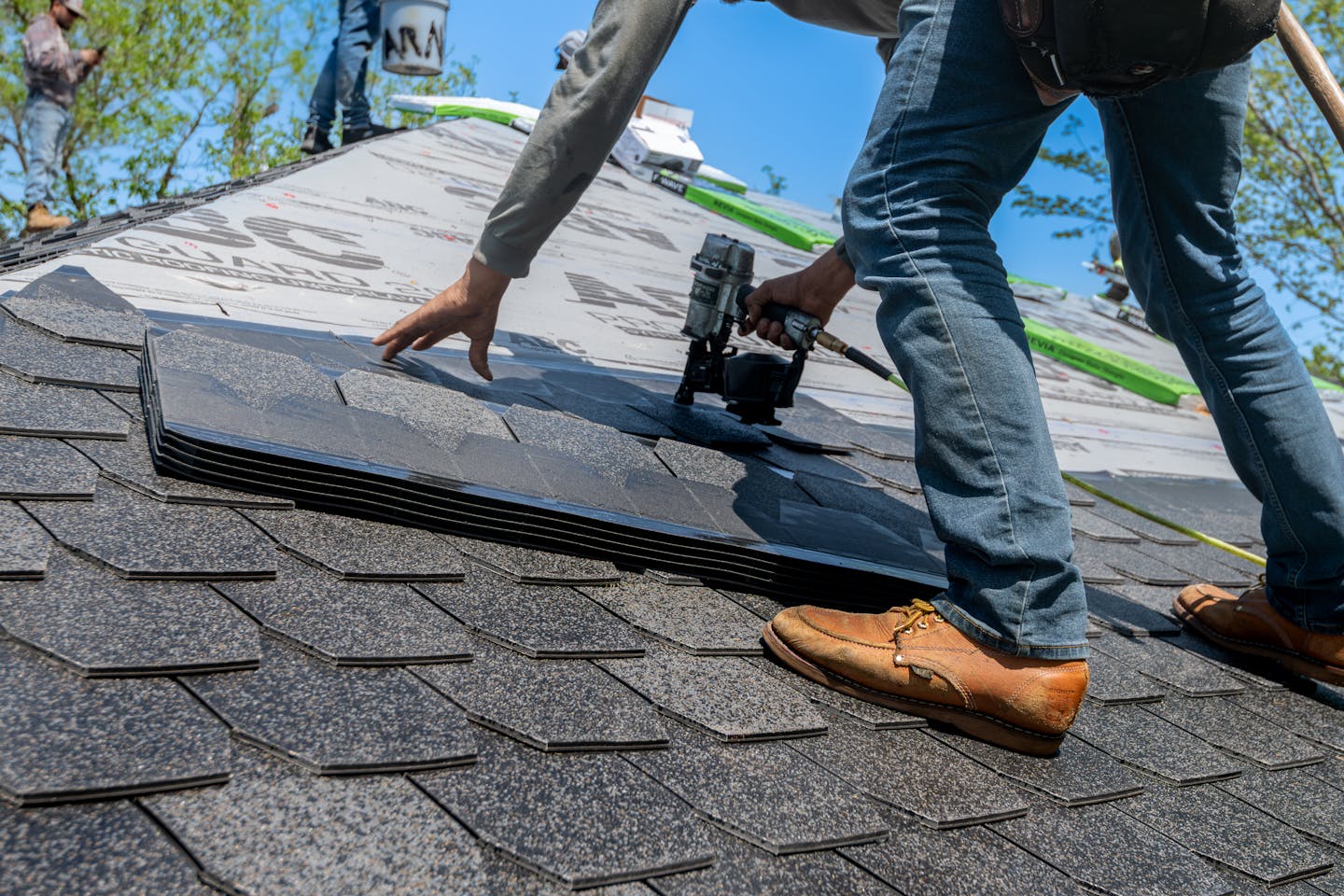
Plumbers can step away from a sink to answer a call. Electricians can check their phone between outlets. In contrast, roofers are 30 feet in the air with nail guns running and material being hoisted. You’re not checking voicemail between bundles of shingles. When your crew is on a tear-off, you’re managing safety, materials, and a dozen subcontractors. Consequently, the phone is the last priority–as it should be.
But contractors lose 30% or more of their leads to slow response times. For a roofer doing $12,000 average jobs, 30% lead loss doesn’t just sting–it’s catastrophic.
Storm Season Creates Roofing Lead Surges You Can’t Handle Manually
Roofing isn’t a steady-flow business. A single hail event can generate more roofing leads in 48 hours than you normally see in a month. According to the National Roofing Contractors Association (NRCA), storm-driven demand is one of the top operational challenges for residential contractors. Colorado’s Front Range, Texas, the Southeast–storm-driven markets all share this pattern. You go from a normal pipeline to 50+ inbound calls in two days.
No office manager can keep up with that volume manually. As a result, calls stack up, voicemails pile up, and web form submissions sit unread. Meanwhile, the homeowners who don’t hear back within an hour have already moved on. In storm markets, the first roofer to respond doesn’t just have an advantage–they have a near-monopoly on that lead.
The Estimate-to-Close Cycle Is Long and Leaky
A roof replacement isn’t an impulse buy. The typical cycle runs 2-6 weeks from first contact to signed contract. During that window, the homeowner is getting other estimates, talking to neighbors, and slowly forgetting about the proposal you left on their kitchen table.
Insurance jobs stretch even longer. Between adjuster visits, supplemental claims, and approval timelines, an insurance roof can take 30-90 days from first contact to contract. That’s 30-90 days where roofing leads can go cold, get poached by a competitor, or simply disappear.
Most roofers don’t follow up on estimates at all. Instead, they hand over the proposal, say “let me know,” and move on to the next inspection. Industry data suggests 40-60% of estimates never get a single follow-up. On $10,000+ jobs, that’s not just sloppy–it’s financially devastating.
Example: A roofing company in the Denver metro gives 15 estimates per week during storm season at an average of $11,000 each. They close 5 on the spot or within a few days. The other 10? No follow-up. If even 2 of those 10 would have closed with a simple reminder sequence, that’s $22,000 per week–over $280,000 across a 13-week season–in revenue that evaporated because nobody sent a text.
Automation 1: Instant Roofing Lead Acknowledgment
The first automation is the most impactful and the simplest to implement. When a lead comes in–missed call, web form, Facebook ad, or Google LSA–they get an immediate response. Not in 10 minutes. Not when you get off the roof. Immediately.
Missed Call Text-Back for Roofing Leads
A homeowner calls your number. You can’t answer because you’re managing a crew on a tear-off in Littleton. Within 5 seconds, they receive a text: “Hey, this is Summit Roofing. Sorry we missed your call–we’re on a job site. What can we help with?”
That single text does three critical things. First, it confirms you’re a real, active business. Second, it stops them from calling the next roofer on their list. Third, it opens a text conversation they can respond to on their own schedule. For a deep dive on exactly how this works, read our complete guide to missed call text-back.
Web Form Auto-Response
A homeowner fills out your “Request a Free Estimate” form at 9 PM after noticing water stains on their ceiling. If the next thing that happens is nothing until Monday morning, you’ve already lost that lead. They filled out your competitor’s form too, and that company texted back in 10 seconds.
Automated web form response works identically to missed call text-back. Form submitted, instant text: “Thanks for reaching out to Summit Roofing. We’ll get an inspection scheduled for you–what’s your availability this week?” The homeowner replies at 9:15 PM. By the time you check in the morning, you have a conversation to pick up–not a cold lead to chase.
Storm-Surge Mode
During a major hail event, your normal lead volume multiplies by 5x or 10x. A good automation system handles this without breaking a sweat. For instance, fifty missed calls in an afternoon means fifty instant texts sent–each one opening a conversation, collecting the address and damage description, and logging the lead in your CRM. Your office manager would need to work a 20-hour day to handle that volume manually. In contrast, the automation handles it in 50 seconds.
Example: A roofing contractor in Colorado Springs gets hit with a June hailstorm. Between 4 PM and 8 PM, 38 roofing leads come in. His crew is still tarping a damaged roof. Without automation, those 38 calls go to voicemail. With automation, 38 homeowners receive an instant text, 22 reply with their address and damage details, and by the next morning the contractor has a prioritized inspection schedule ready to go. Meanwhile, his competitors are still listening to voicemails.
Automation 2: Multi-Touch Estimate Follow-Up
You drove to the house. You climbed on the roof. You measured, photographed, and put together a detailed proposal. Then you handed it to the homeowner and said, “Let me know what you think.” And you never followed up. That inspection cost you 1-2 hours and $50-$100 in fuel and overhead. The proposal represents a $10,000+ potential job. Yet you’re leaving it entirely to the homeowner to come back to you.
Automated estimate follow-up changes that equation completely. Here’s what the sequence looks like for converting roofing leads into signed contracts.
The Follow-Up Timeline
Day 0 — Estimate delivered (in person or via email/text). Confirmation message sent: “Thanks for having us out today. Your estimate for [address] is attached. Questions? Just reply here.”
Day 2 — “Hi [Name], just checking in on the roof estimate for [address]. Any questions I can answer?”
Day 5 — “Wanted to make sure this didn’t get buried in your inbox. We have crew availability over the next two weeks if you’d like to move forward.”
Day 10 — “Quick heads-up–material prices are holding for now, but our supplier has flagged potential increases next month. Happy to lock in your price if you’re ready.”
Day 21 — “Hi [Name], we put together your roof estimate a few weeks ago. Still interested? If timing isn’t right, no worries–just let us know and we’ll check back next season.”
Day 45 — Final touchpoint for insurance jobs: “Just checking in on your claim status. If the adjuster has approved the work, we’d love to get you on the schedule before storm season picks back up.”
Every message fires automatically. Your team only gets involved when the homeowner responds. Most importantly, the sequence is persistent but not pushy–each message adds a reason to act (availability, pricing, timing) rather than just repeating “are you ready yet?”
Insurance Job Follow-Up
Insurance roofs need a different cadence. The homeowner isn’t deciding whether to buy–they’re waiting on an adjuster, a supplement, or an approval. Therefore, the follow-up sequence for insurance jobs should track the claim lifecycle, not the sales cycle.
After inspection: “We’ve documented the damage and can work with your adjuster. Here’s what to expect next.”
After adjuster visit: “How did the adjuster visit go? If you need us to review the scope or file a supplement, just let us know.”
After approval: “Great news that the claim was approved. We have crew availability in [timeframe]–want to lock in a start date?”
Insurance jobs are where follow-up matters most. The timeline is long, the process is confusing for the homeowner, and the roofer who stays in touch throughout the claim process is the one who gets the job when the check arrives. Most competitors disappear after the initial inspection. As a result, staying present–automatically–gives you an enormous advantage.
How many estimates are sitting in homeowners’ inboxes right now with zero follow-up? We’ll map out a follow-up sequence built for your roofing sales cycle.
Automation 3: Post-Job Review Requests
A new roof is one of the most visible improvements a homeowner makes. It looks great, the neighbors notice, and the homeowner feels good about the investment. That’s the perfect moment to ask for a review–and most roofers never do.
Why Roofing Reviews Matter More Than Other Trades
Nobody asks their neighbor to recommend a plumber until something breaks. But a new roof? The neighbors see it going on. They walk by and notice. Then the first thing they do when they get home is check Google reviews for the company whose trucks were parked out front all week.
Roofing is a high-trust, high-dollar purchase. Homeowners research roofers more than almost any other trade contractor. A strong Google review profile doesn’t just help your SEO–it’s the difference between getting on the shortlist and getting passed over. In other words, every 5-star review is a referral that works 24/7.
The Automated Review Sequence
Day 1 after completion: “Hi [Name], your new roof is looking great! We hope you’re happy with the work. If you have a minute, a Google review would mean a lot to our crew: [direct review link].”
Day 4 (if no review yet): “Just a quick follow-up–if you had a good experience with Summit Roofing, a short review helps other homeowners find a roofer they can trust: [link].”
Two touches. That’s it. Not pushy, not annoying–just a gentle reminder at the moment when the homeowner is most satisfied with the work. Automated review requests typically generate 3-5x more reviews than asking manually, because the ask goes out consistently on every single job instead of only when someone remembers.
For roofing companies, every new review compounds. Specifically, a company with 150 five-star reviews dominates local search results over a competitor with 30. And those reviews drive organic roofing leads that don’t cost you a dollar in advertising.
The Revenue Math on Lost Roofing Leads
Let’s make this concrete. These numbers reflect a typical residential roofing company running 2-3 crews.
Average job value: $11,000
Estimates given per week (peak season): 15
Close rate without follow-up: 30%
Close rate with automated follow-up: 42% (industry data shows multi-touch follow-up improves close rates by 25-40%)
Without follow-up: 15 estimates x 30% = 4.5 jobs/week = $49,500/week
With follow-up: 15 estimates x 42% = 6.3 jobs/week = $69,300/week
Difference: $19,800/week. Over a 16-week peak season, that’s $316,800 in additional closed revenue–from roofing leads you already had. You already drove to the house. You already climbed on the roof. You already wrote the proposal. The only thing that changed is what happened after you handed it over.
Now add the missed roofing leads–the calls that came in while you were on a job and never got returned.
Missed calls per week during storm season: 10
Leads recovered by instant text-back: 60% (6 leads)
Close rate on recovered leads: 25%
That’s 1.5 additional jobs per week x $11,000 = $16,500/week, or $264,000 over a 16-week season.
Combined, these two automations alone represent over $500,000 in recoverable revenue per season for a mid-size roofing operation. Even if you cut these estimates in half to be conservative, you’re still looking at a quarter million dollars that’s currently evaporating because of slow follow-up on roofing leads.
“I Don’t Need Automation–I Need More Salespeople”
Maybe. But consider this: a salesperson costs you $50,000-$80,000/year in salary plus commission, plus a truck, plus insurance. And they still can’t respond to a lead at 9 PM on a Saturday.
Automation doesn’t replace your sales process. Instead, it makes your existing process work on roofing leads it’s currently ignoring. A missed call at 7 PM gets an instant text. An estimate from last Tuesday gets a Day 5 follow-up. A completed job gets a review request. None of these require a salesperson–they require a system.
Furthermore, if you do have salespeople, automation makes them more effective. Instead of spending their morning calling through a list of cold leads, they start the day with a list of warm leads who already responded to an automated text. As a result, the salesperson’s time goes to closing instead of chasing.
“Insurance Jobs Are Too Complex to Automate”
The insurance process itself? Absolutely–that requires expertise, relationships with adjusters, and human judgment. However, the follow-up communication around the insurance process is pure routine. And it’s exactly where roofing leads go cold.
For example, the homeowner filed a claim three weeks ago and hasn’t heard from you since. They assume you forgot about them. Then they call another roofer. Meanwhile, you were planning to follow up–you just got buried in other inspections.
Automated follow-up keeps you present throughout the insurance timeline without you having to remember every lead’s claim status. The system tracks where each lead is in the process and sends the right message at the right time. Consequently, you only step in when the homeowner responds or when it’s time for the adjuster meeting.
What You Need to Start Converting More Roofing Leads
You don’t need to overhaul your business. In fact, these automations connect to what you already have.
A CRM or lead tracking system. This could be AccuLynx, JobNimbus, Roofr, or even a well-organized spreadsheet. The automation needs somewhere to log leads and track their status. If you don’t have a CRM yet, that’s actually a good place to start–see our guide on CRM automation for trade contractors.
A business phone number that can send texts. Your existing business line works if it supports texting. If not, a dedicated texting number takes minutes to set up and keeps everything separate from your personal phone.
Your web form and lead sources connected. Google LSA leads, Facebook form submissions, website contact forms–each one needs to trigger the instant response. Most CRMs and automation platforms support these integrations out of the box. For a broader look at business automation for trade contractors, our complete guide walks through every step.
That’s it. No new software to learn. No complicated systems. Just a layer of automation that watches for roofing leads and follows up on estimates–so your crews can stay focused on the work that actually requires being on a roof.
Keep Reading
- Missed Call Text-Back: What It Is and How It Works — The complete guide to the single highest-impact automation for any trade.
- How Many Estimates Are You Forgetting to Follow Up On? — The data on what happens when estimates go unfollowed.
- Why Contractors Lose 30% of Leads Before They Even Call Back — The response-speed problem that hits every trade.
- CRM Automation 101 for Trade Contractors — Where to start if you don’t have a system yet.
- The ROI of Automation for Trade Businesses — How to calculate the payback for your operation.
Stop Leaving Five-Figure Roofing Leads on the Table
You don’t have a demand problem. Homeowners need roofs–that’s not going to change. What you have is a follow-up problem. Roofing leads are coming in and dying in voicemail. Estimates are going out and disappearing into inboxes. Completed jobs are getting zero review requests. And every one of those gaps is costing you real, measurable revenue.
The roofing companies that are growing right now aren’t the ones with the biggest crews. Instead, they’re the ones whose roofing leads get a response in 5 seconds instead of 5 hours, whose estimates get followed up automatically instead of never, and whose happy customers leave Google reviews without anyone on the team having to remember to ask.
Book a free 15-minute workflow fit check. We’ll look at your current lead flow, estimate how much revenue is leaking out of your follow-up gaps, and map out what these three automations would look like for your specific setup–whether you’re running AccuLynx, JobNimbus, or a stack of Post-it notes.
No contracts. No subscriptions. Just a clear picture of what’s sitting on the table–and how to pick it up.